Etruscan Tombs Were Adorned With Art Depicting Festive Occasions A True B False
The Etruscans flourished in central Italian republic from the 8th to 3rd century BCE, and 1 of their greatest legacies is the beautifully painted tombs constitute in many of their of import towns. Tarquinia, Cerveteri, Chiusi, and Vulci, in item, possess tombs with outstanding wall paintings which depict lively and colourful scenes from Etruscan mythology and daily life, and, sometimes, even the tomb'south occupant themselves. Equally the civilization was ruthlessly crushed, absorbed and eliminated almost without trace past the all-acquisition Romans, these tomb paintings are a tantalising glimpse into the lost earth of the Etruscans.
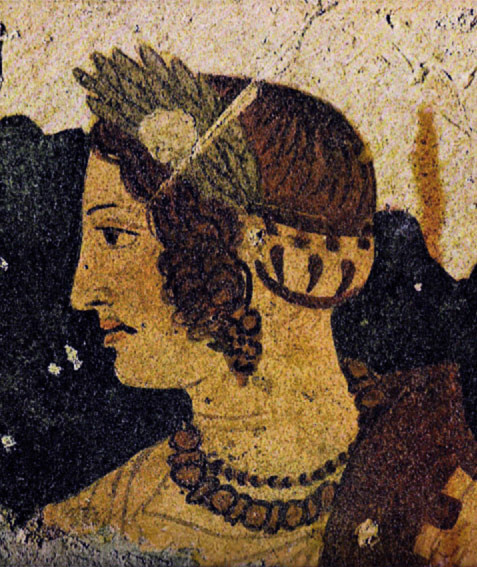
Velcha, Tomb of Orcus, Tarquinia
Techniques & Purpose
The colours used past Etruscan artists were made from paints of organic materials. White came from chalk or kaolin, black from a vegetable mix, and light-green from malachite. Cerise, ochre and xanthous came from iron oxides. Blue occurs rarely and was perhaps made from imported material. At that place is very picayune use of shading until influence from Greek artists via Magna Graecia and their new chiaroscuro method with its strong contrasts of low-cal and night in the 4th century BCE.
Magnificent though these paintings are, it is to exist remembered that they were not seen past anyone except at the burial ceremony or perhaps briefly when another family member was later interred.
At Tarquinia, the paintings are applied to a sparse base layer of plaster wash with the artists commencement drawing outlines using chalk or charcoal. In contrast, many of the wall paintings at Cerveteri and Veii were applied directly to the stone walls without a plaster underlayer. This has, unfortunately, meant that they take deteriorated much more at other Etruscan sites. Chiusi'south Tomb of the Monkey offers another intriguing insight into technique. There the artist may accept used a template for his subjects as not only do some of the scenes closely resemble those in tombs at Tarquinia but besides a pair of boxers, who stand up facing each other, mirror each other's outlines exactly.
Magnificent though these paintings are, it is to be remembered that they were not seen by anyone except at the burying ceremony or peradventure briefly when another family fellow member was later interred. The tombs, then, are a supreme example of conspicuous consumption – an elite (only two% of tombs were painted) demonstrating in a brief moment their wealth and superiority within the community. Beyond, this, though, the paintings accept another purpose and about certainly a more important one. The Etruscan tomb paintings show that these people believed in an afterlife and that such decoration, forth with the provision of grave goods from aureate jewellery to dinner sets, somehow comforted and helped the deceased on their journeying into that new and unknown earth.
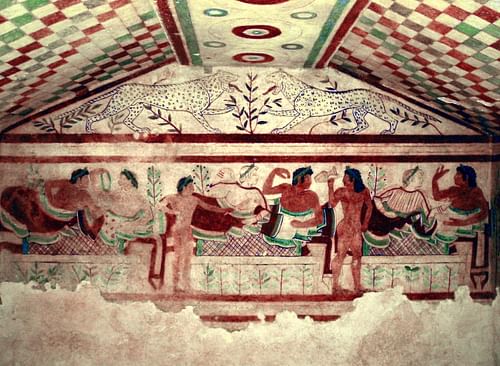
Tomb of The Lionesses, Tarquinia
General Subjects
The earliest painted Etruscan tombs date to the mid-6th century BCE and have only painted heraldic figures around doorways or the primal wide column supporting two entrances. These are typically representations of sphinxes or mythical monsters which acted every bit guardians and show an influence from Phoenicia and the Most East. The 6th-century BCE Campana Tomb at Veii is a good case of this type. In subsequent centuries the walls of tombs of the Etruscan aristocracy were painted more ambitiously with portions of the tomb divided for specific types of decoration: a dado at the bottom, a large central space, a pinnacle cornice or entablature, and the triangular infinite reaching the ceiling like the pediment of a classical temple.
In the large central wall infinite and pediment area colourful and lively scenes were painted from mythology, religious practices and ceremonies, and Etruscan daily life, especially outdoor banquets, dancing, hunting, fishing, and sporting events such equally funerary games with competitions of running, jumping, wrestling, boxing, and discus. There is also the occasional erotic scene. Musicians are some other common subject, playing tortoiseshell lyres, castanets, and the double aulos flute. These instruments, the reclining diners on low one-armed couches, wine-mixing vessels, and the symposium game of throwing wine slops into a vase (kottabos) all show a Greek, and particularly Ionian, influence.
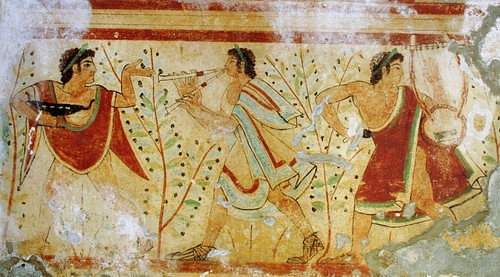
Musicians Wall-painting, Tarquinia
The tombs, perhaps surprisingly, have very few scenes connected with burying and death and, instead, concentrate on the joys of living. Feasting is a scene repeated over and over again at tombs beyond Etruscan sites. Indeed, the Etruscans were famous throughout the Mediterranean for their lives of luxury and banquets stuffed with exotic foodstuffs. The scenes give an important insight into social status equally they show that Etruscan women could attend drinking parties when their counterparts in Greece could not. There only courtesans could entertain the guests, but the inscriptions of some scenes indicate that respectable women participated on an equal footing with males in these Etruscan soirées. We tin merely speculate the true significance of the painted banquets. Are they depictions of the deceased in a happy moment long since passed or mourners putting on a funeral feast for their lost loved one? Could they even be a view of the afterlife where food and beverage and merriment never cease? Maybe, nosotros shall never know.
Other decorative elements in the tomb paintings include architectural features which are nowadays framing such scenes mentioned in a higher place or are fifty-fifty depicted in them. Tombs frequently take a painted door and frame, for example, equally a metaphor for the deceased's passage into the adjacent life. Other features actualization in paint include windows and columns, and these are helpful in substantiating archaeological excavations of real Etruscan buildings.
The Tombs at Tarquinia
Tarquinia has effectually 200 Etruscan tombs, which were rich in artefacts and decorated with magnificent wall-paintings earning it the status of a UNESCO World Heritage site. The earliest tombs are rectangular rock-cut chambers which are painted to replicate the architectural features of existent houses. Others take ceilings painted to mimic tent textile, alluding to the earlier Etruscan practise of using tents to comprehend the deceased. Mythical creatures are commonly painted on pillars and banquet scenes near the ceilings. Later tombs have false doorways and more ambitious painted scenes covering entire walls, especially of diners reclining on couches, drinkers on mats, hunting, games, and figures bidding a fond good day to the deceased.
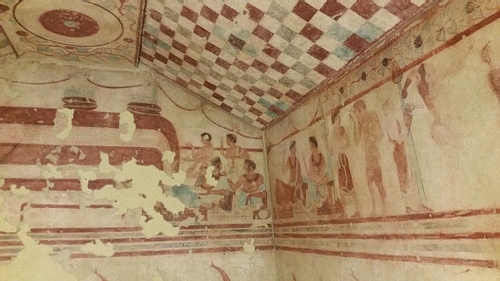
Tomb of the Funeral Couch, Tarquinia
The Tomb of the Bulls, dating to 540-530 BCE, has the name of its occupant painted on ane wall: Aranth Spurianas. Painted scenes include Achilles attacking Troilus, the immature Trojan prince. A frieze to a higher place this scene shows two copulating couples (one heterosexual trio and one homosexual couple) and two bulls. Another wall in the tomb has the myth of Bellerophon and Pegasus with the hero riding a equus caballus and facing the Chimera and a sphinx. Finally, there is a scene of a young man riding a hippocamp (mythical sea-equus caballus) over the ocean, perhaps as a metaphor for the tomb occupant'south journey into the next life.
The misleadingly named Tomb of the Lionesses, built 530-520 BCE, actually has two painted panthers, a large drinking party scene, and is interesting for its unusual checkered blueprint ceiling and six painted wooden columns. There is likewise a fine frieze of dolphins, birds, palmettes and lotus flowers. The Tomb of the Augurs (c. 520 BCE) has a scene of two nude wrestlers – named as Teitu and Latithe and probably slaves - while between them lies 3 bowls, the prizes for the victor. There is also a representation of a figure who appears in several other tombs, Phersu - a human wearing a black-disguised mask who holds a ferocious dog on a long leash which attacks a man whose caput is wrapped in a cloth.
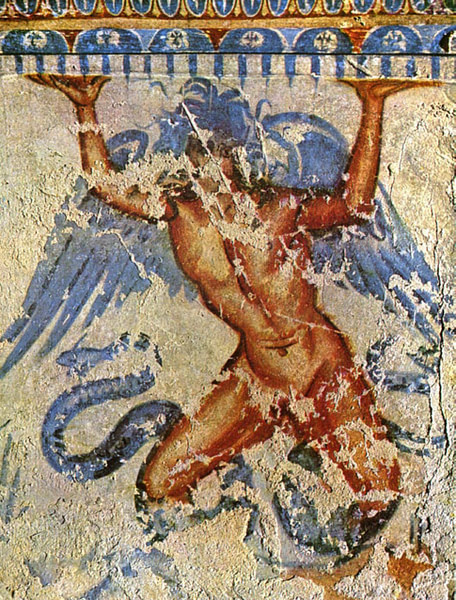
Typhon, Tarquinia
The Tomb of The Businesswoman (named after its discoverer Baron Kestner), dating to c. 510 BCE, has various human figures either continuing or riding, and these include a woman caught in the act of saying farewell, presumably to the tomb's occupant. Contemporary with this tomb is the Cardarelli Tomb (named after a local poet), which has a scene of a woman, wearing a flowing cape and crimson pointed shoes, accompanied by a slave daughter and male child, the latter carrying a fan. Other figures include two nude boxers, dancers, and musicians.
The c. 480 BCE Tomb of the Bigas has a representation of able-bodied games and a chariot (bighe) race watched past a big crowd of spectators imaginatively drawn with some figures in three-quarter view and others foreshortened to provide perspective. The Tomb of the Dying and the Tomb of the Dead Man (c. 470 BCE) are unusual in that they really portray the occupant laid out on their deathbed surrounded by mourning relatives. Finally, the Tomb of the Blue Demons (420-400 BCE) gives a rare glimpse of the Etruscan vision of the underworld (or maybe a view now more than heavily influenced by Greek ideas). Here information technology is inhabited by blue- and black-skinned demons, i of which holds two snakes, but there are also the more welcoming, already expressionless relatives of the tomb's occupant, awaiting their reunification in the afterlife.
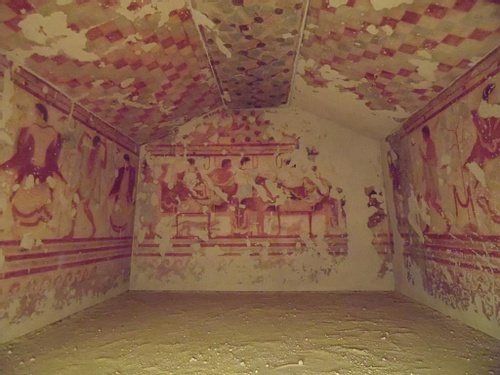
Tomb of the Triclinium
The Tomb of the Monkey at Chiusi
Tombs with wall paintings include the Tomb of the Monkey, constructed 480-470 BCE, which has a scene of a monkey sitting in a tree and another where a adult female wearing a red robe is shown sitting nether a parasol with her feet up on a stool while she watches a parade of jugglers, athletes, dancers, and chariots. Another female figure is dancing while balancing an incense burner on her head in guild to provide a target for drinkers to throw their wine slops at. The ceiling has an interesting unmarried painted coffer which has four sirens supporting a rosette with a four-leafed plant. The motif would reappear in later Roman and early Christian compages but with angels instead of sirens.
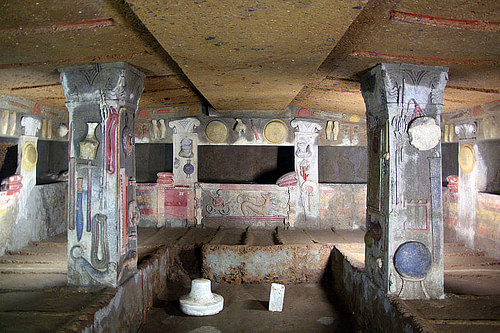
Tomb of the Reliefs, Cerveteri
The Tomb of the Stucco Reliefs at Cerveteri
The excellent Tomb of the Stucco Reliefs was constructed at Cerveteri for the Matuna family during the last quarter of the quaternary century BCE. Information technology is accessed via a steep stepped corridor which opens into a chamber with stone benches on all sides and places for 32 bodies. The chamber's two columns and walls are covered in painted stucco depictions of everyday objects such as rope, banners, jugs, cutlery, axes, fans, bed linen, armour, trumpets, and even board games. Many of the objects hang from nails in faux of the typical Etruscan household where storage cabinets were largely unknown and possessions were hung from the walls. Animals as well appear seemingly at random with geese, ducks, and even a pet Maltese domestic dog chasing a cadger.
The Francois Tomb at Vulci
Vulci's outstanding contribution to Etruscan wall painting is the late fourth-century BCE Francois Tomb, named afterwards its discoverer Alessandro Francois. The atrium of the tomb had ii chief scenes, both of which are bloody massacres: an episode from Theban myth and another from Homer's Iliad. The former shows Eteocles (King of Thebes and son of Oedipus) and his blood brother Polyneikes, both nude, just at the moment of killing each other with their swords and claret spurting everywhere. The scene from the Iliad shows the cede of Trojan prisoners during the funeral of Achilles' favourite sidekick Patroclus. Also depicted are the figures of Charun, the gatekeeper to the underworld carrying his usual hammer, and a winged Vanth, i of the Etruscan female messenger divinities.

Battle Scene, Francois Tomb, Vulci
Another wall seems to be a representation of an actual boxing betwixt the Etruscans of Vulci and rivals from the Etruscan towns of Volsinii and Sovana. To add some other layer of complication, several of the x figures are named along with their town in Etruscan, and while some have Etruscan names, others have Roman ones, in reference perhaps to the 6th-century BCE conflict betwixt the Etruscans and Romans which saw various dynastic power struggles where several of Rome'southward early kings were of Etruscan origin.
The names in the battle include three heroes of Vulci: Macstrna, who may exist Rome's legendary 2d Etruscan rex Servius Tullius by another proper name, and Caile and Avle Vipinas (2 brothers) who probably were actual historical figures with tradition stating that they had settled in Rome on the Caelian Hill. Macstrna is in the act of freeing Caile Vipinas whose hands are tied, while Avle Vipinas and iii others, presumably also from Vulci, attack with swords a coalition group from Volsinii, Sovana, and Rome. The Roman is identified as Cnaeus Tarquinius (Cneve Tarchunies Rumach), and he is cowering below the sword of Marce Camitlnas about to be killed. Some historians regard the Roman figure as Tarquinius Priscus, the legendary king of Rome (r. 616-579 BCE), or a younger relation. If it is the king, then the painting provides an alternative to the Roman tradition that Priscus was assassinated by his sons. The Francois Tomb would suggest that he lost his throne in battle with the Etruscans.
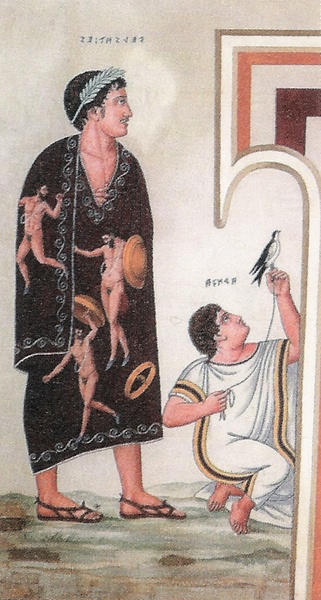
Vel Saties & Arnza, Francois Tomb
Another painting in the tomb, originally located by the doorway of the atrium, shows a man named in an inscription every bit Vel Saties, perhaps the occupant of the tomb. The figure, possibly a magistrate or auspicium (reader of omens), wears a dark blue embroidered cloak which has several nude male figures who are dancing while carrying shields. The man besides wears a laurel crown and is accompanied past a dwarf who is named as Arnza. The dwarf is kneeling while holding a woodpecker or consume attached to a string. The bird is virtually to exist released, and Vel Saties looks on, mayhap, as in one interpretation, he is about to read the flying of the bird and divine its significance as an omen, a do common in the Etruscan organized religion. Alternative interpretations advise the bird is no more than a child'due south pet, and a third that Vel Saties gazes at the bird nigh to exist released in a metaphor for his own imminent passage into the next life.
This article has been reviewed for accuracy, reliability and adherence to academic standards prior to publication.
Source: https://www.worldhistory.org/article/1013/etruscan-tomb-paintings/
0 Response to "Etruscan Tombs Were Adorned With Art Depicting Festive Occasions A True B False"
Postar um comentário