what needs to be considered when choosing a research design
Without a doubt, 1 of the most common questions nosotros receive at Grad Coach is "How exercise I choose the correct methodology for my inquiry?". It's easy to see why – with so many options on the research design table, it's easy to go intimidated, peculiarly with all the complex lingo!
In this post, nosotros'll explain the three overarching types of enquiry – qualitative, quantitative and mixed methods – and how yous can go about choosing the all-time methodological approach for your inquiry.
Overview: Choosing Your Methodology
- Understanding the options
- Qualitative enquiry
- Quantitative research
- Mixed methods-based research
- Choosing a research methodology
- Nature of the enquiry
- Research expanse norms
- Practicalities
1. Understanding the options
Before we spring into the question of how to choose a research methodology, it'due south useful to take a pace back to sympathize the iii overarching types of research – qualitative, quantitative and mixed methods-based research. Each of these options takes a different methodological approach.
Qualitative enquiry utilises data that is non numbers-based. In other words, qualitative research focuses on words, descriptions, concepts or ideas – while quantitative inquiry makes employ of numbers and statistics. Qualitative research investigates the "softer side" of things to explore and draw, while quantitative inquiry focuses on the "hard numbers", to measure differences betwixt variables and the relationships between them.
Importantly, qualitative research methods are typically used to explore and gain a deeper understanding of the complexity of a situation – to draw a rich motion-picture show. In contrast to this, quantitative methods are usually used to confirm or exam hypotheses. In other words, they have distinctly different purposes. The table below highlights a few of the primal differences betwixt qualitative and quantitative research – you can learn more about the differences here.
Qualitative Research
- Uses an inductive approach
- Is used to build theories
- Takes a subjective approach
- Adopts an open and flexible approach
- The researcher is shut to the respondents
- Interviews and focus groups are oftentimes used to collect word-based data.
- Generally, draws on minor sample sizes
- Uses qualitative information analysis techniques (east.g. content analysis, thematic analysis, etc)
Quantitative Enquiry
- Uses a deductive approach
- Is used to test theories
- Takes an objective arroyo
- Adopts a airtight, highly planned approach
- The research is disconnected from respondents
- Surveys or laboratory equipment are often used to collect number-based data.
- Generally, requires big sample sizes
- Uses statistical analysis techniques to brand sense of the data
Mixed methods-based research, as you'd wait, attempts to bring these two types of research together, cartoon on both qualitative and quantitative data. Quite oft, mixed methods-based studies volition use qualitative research to explore a situation and develop a potential model of understanding (this is called a conceptual framework), and then go on to use quantitative methods to exam that model empirically.
In other words, while qualitative and quantitative methods (and the philosophies that underpin them) are completely dissimilar, they are non at odds with each other. It'south non a competition of qualitative vs quantitative. On the contrary, they can be used together to develop a loftier-quality piece of research. Of course, this is easier said than done, so we usually recommend that first-time researchers stick to a unmarried approach, unless the nature of their study truly warrants a mixed-methods approach.
The key takeaway here, and the reason we started by looking at the three options, is that information technology's important to understand that each methodological approach has a different purpose – for example, to explore and understand situations (qualitative), to examination and measure (quantitative) or to practise both. They're not simply culling tools for the aforementioned task.
Correct – now that nosotros've got that out of the fashion, let's look at how you can go near choosing the right methodology for your research.

2. How to choose a inquiry methodology
To cull the right research methodology for your dissertation or thesis, y'all need to consider three important factors. Based on these three factors, you can determine on your overarching approach – qualitative, quantitative or mixed methods. Once you've fabricated that decision, yous can flesh out the finer details of your methodology, such as the sampling, information collection methods and analysis techniques (we discuss these separately in other posts).
The three factors you demand to consider are:
- The nature of your research aims, objectives and research questions
- The methodological approaches taken in the existing literature
- Practicalities and constraints
Permit's accept a look at each of these.
Cistron #1: The nature of your inquiry
As I mentioned earlier, each type of research (and therefore, research methodology), whether qualitative, quantitative or mixed, has a different purpose and helps solve a dissimilar type of question. So, information technology's logical that the central deciding factor in terms of which inquiry methodology you adopt is the nature of your research aims, objectives and research questions.
But, what types of inquiry be?
Broadly speaking, inquiry can fall into i of three categories:
- Exploratory – getting a better agreement of an consequence and potentially developing a theory regarding it
- Confirmatory – confirming a potential theory or hypothesis past testing it empirically
- A mix of both – building a potential theory or hypothesis and so testing it
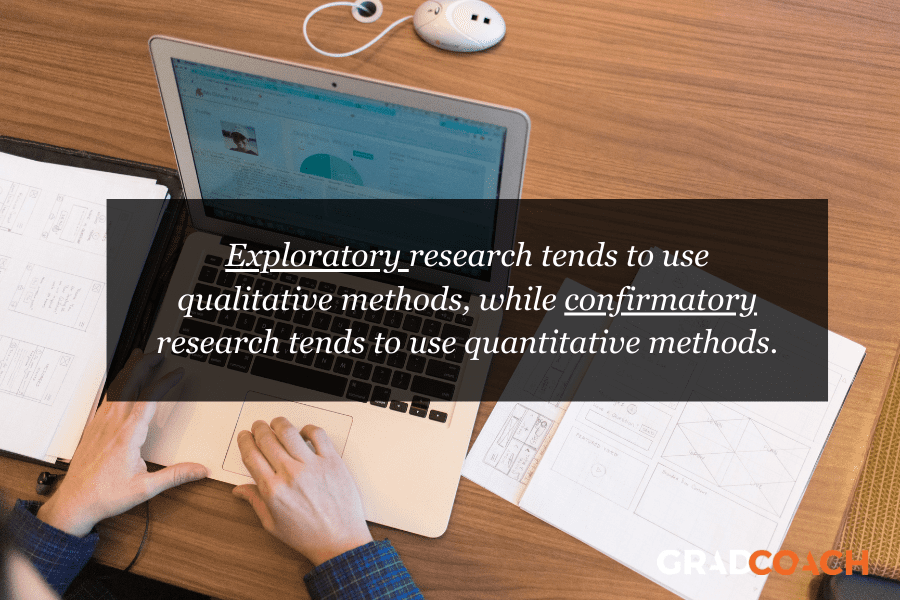
As a dominion of thumb, exploratory research tends to prefer a qualitative approach, whereas confirmatory enquiry tends to use quantitative methods. This isn't set in rock, but it's a very useful heuristic. Naturally then, research that combines a mix of both, or is seeking to develop a theory from the ground up and so examination that theory, would utilize a mixed-methods approach.
Let'southward look at an case in activeness.
If your inquiry aims were to understand the perspectives of war veterans regarding certain political matters, you'd likely adopt a qualitative methodology, making use of interviews to collect information and one or more qualitative data assay methods to make sense of the data.
If, on the other hand, your enquiry aims involved testing a set of hypotheses regarding the link betwixt political leaning and income levels, yous'd likely adopt a quantitative methodology, using numbers-based data from a survey to measure out the links between variables.
And so, the get-go (and most of import thing) thing you lot need to consider when deciding which methodological approach to use for your research projection is the nature of your inquiry aims, objectives and inquiry questions. Specifically, you need to assess whether your research leans in an exploratory or confirmatory direction or involves a mix of both.
The importance of achieving solid alignment between these three factors and your methodology can't be overstated. If they're misaligned, you're going to be forcing a square peg into a round hole. In other words, you'll be using the wrong tool for the chore, and your research will get a disjointed mess.
If your research is a mix of both exploratory and confirmatory, but yous have a tight give-and-take count limit, you may need to consider trimming downward the telescopic a piddling and focusing on i or the other. I methodology executed well has a far better take chances of earning marks than a poorly executed mixed methods approach. And so, don't endeavour to be a hero, unless there is a very potent underpinning logic.
Factor #2: The disciplinary norms
Choosing the right methodology for your research as well involves looking at the approaches used by other researchers in the field, and studies with similar research aims and objectives to yours. Oftentimes, within a discipline, in that location is a common methodological approach (or set of approaches) used in studies. While this doesn't mean y'all should follow the herd "just because", you should at to the lowest degree consider these approaches and evaluate their merit within your context.
A major benefit of reviewing the research methodologies used by similar studies in your field is that yous can often piggyback on the information collection techniques that other (more than experienced) researchers accept developed. For instance, if you're undertaking a quantitative study, you tin oft find tried and tested survey scales with loftier Cronbach's alphas. These are unremarkably included in the appendices of journal articles, so you don't even have to contact the original authors. By using these, yous'll relieve a lot of time and ensure that your report stands on the proverbial "shoulders of giants" by using high-quality measurement instruments.
Of class, when reviewing existing literature, continue point #1 front of listen. In other words, your methodology needs to marshal with your research aims, objectives and questions. Don't fall into the trap of adopting the methodological "norm" of other studies just because it's pop. But adopt that which is relevant to your enquiry.
Factor #3: Practicalities
When choosing a enquiry methodology, there volition always be a tension between doing what'southward theoretically best (i.eastward., the nearly scientifically rigorous research design) and doing what's practical, given your constraints. This is the nature of doing inquiry and there are always trade-offs, as with annihilation else.
But what constraints, you ask?
When y'all're evaluating your methodological options, you need to consider the post-obit constraints:
- Data admission
- Time
- Money
- Equipment and software
- Your knowledge and skills
Let's wait at each of these.
Constraint #one: Information access
The beginning practical constraint y'all need to consider is your access to data. If you're going to be undertaking main research, you need to think critically about the sample of respondents you realistically have access to. For example, if you plan to use in-person interviews, you lot need to inquire yourself how many people you'll need to interview, whether they'll be agreeable to being interviewed, where they're located, and then on.
If you're wanting to undertake a quantitative approach using surveys to collect data, you lot'll need to consider how many responses you lot'll crave to attain statistically significant results. For many statistical tests, a sample of a few hundred respondents is typically needed to develop convincing conclusions.
So, think carefully about what data yous'll need access to, how much information y'all'll need and how you'll collect information technology. The last matter yous desire is to spend a huge amount of time on your enquiry merely to find that you can't go access to the required data.

Constraint #2: Fourth dimension
The next constraint is time. If you're undertaking research as part of a PhD, you may have a adequately open up-ended time limit, but this is unlikely to be the case for undergrad and Masters-level projects. So, pay attention to your timeline, as the data drove and analysis components of different methodologies have a major impact on time requirements. Too, go along in mind that these stages of the research often take a lot longer than originally anticipated.
Another practical implication of time limits is that it will directly affect which time horizon y'all can employ – i.e. longitudinal vs cross-exclusive. For instance, if you've got a half dozen-month limit for your entire research project, it's quite unlikely that yous'll exist able to adopt a longitudinal fourth dimension horizon.
Constraint #3: Money
Every bit with and then many things, coin is another important constraint you'll need to consider when deciding on your research methodology. While some inquiry designs volition price near zero to execute, others may require a substantial budget.
Some of the costs that may arise include:
- Software costs – e.1000. survey hosting services, analysis software, etc.
- Promotion costs – e.g. advertising a survey to attract respondents
- Incentive costs – due east.g. providing a prize or cash payment incentive to concenter respondents
- Equipment rental costs – e.yard. recording equipment, lab equipment, etc.
- Travel costs
- Food & beverages
These are just a scattering of costs that can pitter-patter into your research budget. Like virtually projects, the bodily costs tend to be higher than the estimates, so be certain to err on the conservative side and wait the unexpected. It's critically important that you lot're honest with yourself about these costs, or you could end up getting stuck midway through your project because yous've run out of money.

Constraint #four: Equipment & software
Another applied consideration is the hardware and/or software you'll need in society to undertake your research. Of form, this variable will depend on the type of information you're collecting and analysing. For case, y'all may demand lab equipment to analyse substances, or you may need specific analysis software to analyse statistical data. So, be certain to think about what hardware and/or software yous'll demand for each potential methodological approach, and whether you accept access to these.
Constraint #5: Your cognition and skillset
The last applied constraint is a big 1. Naturally, the inquiry process involves a lot of learning and development along the manner, so you will accrue knowledge and skills equally you progress. However, when considering your methodological options, you should still consider your current position on the ladder.
Some of the questions you should ask yourself are:
- Am I more of a "numbers person" or a "words person"?
- How much exercise I know nearly the analysis methods I'll potentially use (e.g. statistical analysis)?
- How much practice I know virtually the software and/or hardware that I'll potentially utilise?
- How excited am I to learn new enquiry skills and gain new cognition?
- How much time do I have to acquire the things I demand to learn?
Answering these questions honestly will provide you with another set of criteria confronting which you can evaluate the research methodology options you've shortlisted.
So, as yous tin encounter, at that place is a wide range of practicalities and constraints that you need to take into business relationship when y'all're deciding on a research methodology. These practicalities create a tension between the "ideal" methodology and the methodology that y'all tin realistically pull off. This is perfectly normal, and information technology's your job to find the selection that presents the best set of merchandise-offs.
Recap: Choosing a methodology
In this post, we've discussed how to get about choosing a research methodology. The iii major deciding factors we looked at were:
- Nature of the enquiry
- Exploratory
- Confirmatory
- Combination
- Research area norms
- Practicalities
- Data access
- Time
- Money
- Hardware and software
- Your cognition and skillset
If you take any questions, feel gratis to go out a comment below. If you'd like a helping hand with your enquiry methodology, bank check out our i-on-one inquiry coaching service, or book a free consultation with a friendly Grad Motorbus.
Source: https://gradcoach.com/choose-research-methodology/
0 Response to "what needs to be considered when choosing a research design"
Postar um comentário