Crazy Lady Goes Off on Family in Hospital

The lunatic aviary (alternatively mental asylum or insane asylum) was an early precursor of the mod psychiatric hospital.
The fall of the lunatic asylum and its eventual replacement by modern psychiatric hospitals explains the rise of organized, institutional psychiatry. While there were before institutions that housed the "insane", the conclusion that institutionalization was the correct solution to treating people considered to be "mad" was role of a social process in the 19th century that began to seek solutions outside for families and local communities.
History [edit]
Medieval era [edit]
In the Islamic world, the Bimaristans were described by European travellers, who wrote virtually their wonder at the care and kindness shown to lunatics. In 872, Ahmad ibn Tulun built a hospital in Cairo that provided care to the insane, which included music therapy.[1] Nonetheless, concrete historian Roy Porter cautions against idealising the role of hospitals generally in medieval Islam, stating that "They were a drop in the ocean for the vast population that they had to serve, and their true role lay in highlighting ideals of compassion and bringing together the activities of the medical profession."[2] : 105
In Europe during the medieval era, a small subsection of the population of those considered mad were housed a variety of institutional settings. Porter gives examples of such locales where some of the insane were cared for, such as in monasteries. A few towns had towers where madmen were kept (chosen Narrentürme in German, or "fools' towers")[ citation needed ]. The aboriginal Parisian hospital Hôtel-Dieu as well had a small-scale number of cells set aside for lunatics, whilst the boondocks of Elbing boasted a madhouse, the Tollhaus, attached to the Teutonic Knights' infirmary.[iii] Dave Sheppard's Evolution of Mental Health Law and Practice begins in 1285 with a case that linked "the instigation of the devil" with beingness "frantic and mad".[4]
In Spain, other such institutions for the insane were established after the Christian Reconquista; facilities included hospitals in Valencia (1407), Zaragoza (1425), Seville (1436), Barcelona (1481) and Toledo (1483).[2] : 127 In London, England, the Priory of Saint Mary of Bethlehem, which later became known more than notoriously as Clamor, was founded in 1247. At the first of the 15th century, it housed six insane men.[2] : 127 The former lunatic aviary, Het Dolhuys, established in the 16th century in Haarlem, the Netherlands, has been adjusted as a museum of psychiatry, with an overview of treatments from the origins of the building up to the 1990s.
Emergence of public lunatic asylums [edit]

The level of specialist institutional provision for the care and control of the insane remained extremely express at the turn of the 18th century. Madness was seen principally as a domestic problem, with families and parish authorities in Europe and England central to regimens of care.[5] : 154 [vi] : 439 Diverse forms of outdoor relief were extended by the parish government to families in these circumstances, including financial support, the provision of parish nurses and, where family care was not possible, lunatics might be 'boarded out' to other members of the local community or committed to private madhouses.[6] : 452–56 [7] : 299 Uncommonly, if those accounted mad were judged to be particularly disturbing or tearing, parish government might meet the not inconsiderable costs of their confinement in charitable asylums such every bit Bethlem, in Houses of Correction or in workhouses.[8] : thirty, 31–35, 39–43
In the belatedly 17th century, this model began to change, and privately run asylums for the insane began to proliferate and expand in size. Already in 1632 it was recorded that Bethlem Purple Hospital, London had "below stairs a parlor, a kitchen, 2 larders, a long entry throughout the house, and 21 rooms wherein the poor distracted people lie, and above the stairs eight rooms more for servants and the poor to lie in".[ix] Inmates who were deemed dangerous or disturbing were chained, but Bethlem was an otherwise open building. Its inhabitants could roam around its confines and peradventure throughout the general neighborhood in which the infirmary was situated.[x] In 1676, Bethlem expanded into newly built premises at Moorfields with a capacity for 100 inmates.[v] : 155 [11] : 27

A second public charitable institution was opened in 1713, the Bethel in Norwich. It was a small facility which generally housed betwixt twenty and 30 inmates.[5] : 166 In 1728 at Guy's Hospital, London, wards were established for chronic lunatics.[12] : xi From the mid-eighteenth century the number of public charitably funded asylums expanded moderately with the opening of St Luke's Hospital in 1751 in Upper Moorfields, London; the establishment in 1765 of the Infirmary for Lunatics at Newcastle upon Tyne; the Manchester Lunatic Hospital, which opened in 1766; the York Asylum in 1777 (not to be confused with the York Retreat); the Leicester Lunatic Asylum (1794), and the Liverpool Lunatic Asylum (1797).[eleven] : 27
A like expansion took place in the British American colonies. The Pennsylvania Hospital was founded in Philadelphia in 1751 as a outcome of work begun in 1709 by the Religious Guild of Friends. A portion of this infirmary was set autonomously for the mentally sick, and the starting time patients were admitted in 1752.[13] Virginia is recognized as the first state to establish an establishment for the mentally ill.[14] Eastern State Infirmary, located in Williamsburg, Virginia, was incorporated in 1768 under the name of the "Public Hospital for Persons of Insane and Disordered Minds" and its first patients were admitted in 1773.[xiii] [15]
Trade in lunacy [edit]
Due, perhaps, to the absence of a centralised country response to the social problem of madness until the 19th century, private madhouses proliferated in 18th century United kingdom on a calibration unseen elsewhere.[v] : 174 References to such institutions are limited for the 17th century but it is evident that past the start of the 18th century, the so-chosen 'trade in lunacy' was well established.[12] : 8–9 Daniel Defoe, an ardent critic of private madhouses,[16] : 118 estimated in 1724 that there were fifteen then operating in the London surface area.[17] : 9 Defoe may take exaggerated but exact figures for individual metropolitan madhouses are bachelor just from 1774, when licensing legislation was introduced: sixteen institutions were recorded.[17] : 9–10 At least 2 of these, Hoxton Business firm and Wood's Shut, Clerkenwell, had been in operation since the 17th century.[17] : 10 Past 1807, the number had increased to seventeen.[17] : 9 This express growth in the number of London madhouses is believed probable to reflect the fact that vested interests, specially the College of Physicians, exercised considerable command in preventing new entrants to the market.[17] : x–11 Thus, rather than in that location beingness a proliferation of private madhouses in London, existing institutions tended to expand considerably in size.[17] : x The establishments which increased well-nigh during the 18th century, such as Hoxton House, did so past accepting pauper patients rather than private, middle class, fee-paying patients.[17] : eleven Significantly, pauper patients, different their private counterparts, were not subject to inspection nether the 1774 legislation.[17] : 11
Fragmentary evidence indicates that some provincial madhouses existed in Britain from at to the lowest degree the 17th century and possibly earlier.[five] : 175 [12] : 8 A madhouse at Kingsdown, Box, Wiltshire was opened during the 17th century.[five] : 176 [17] : 11 Further locales of early businesses include one at Guildford in Surrey which was accepting patients by 1700, one at Fonthill Gifford in Wiltshire from 1718, another at Hook Norton in Oxfordshire from near 1725, i at St Albans dating from around 1740, and a madhouse at Fishponds in Bristol from 1766.[5] : 176 [17] : 11 It is probable that many of these provincial madhouses, as was the instance with the exclusive Ticehurst House, may take evolved from householders who were boarding lunatics on behalf of parochial authorities and later formalised this practice into a business venture.[5] : 176 The vast majority were small-scale in scale with only 7 asylums exterior London with in excess of thirty patients by 1800 and somewhere betwixt 10 and twenty institutions had fewer patients than this.[v] : 178
Humanitarian reform [edit]
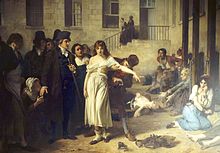
Dr. Philippe Pinel at the Salpêtrière, 1795 by Tony Robert-Fleury. Pinel ordering the removal of chains from patients at the Paris Asylum for insane women.

The joint counties' lunatic asylum, erected at Abergavenny, 1850
During the Age of Enlightenment, attitudes towards the mentally ill began to alter. It came to exist viewed as a disorder that required compassionate handling that would aid in the rehabilitation of the victim. When the ruling monarch of the United Kingdom, George III, who suffered from a mental disorder, experienced a remission in 1789, mental illness came to be seen every bit something which could exist treated and cured. The introduction of moral handling was initiated independently by the French md Philippe Pinel and the English Quaker William Tuke.[18]
In 1792, Pinel became the chief medico at the Bicêtre Hospital in Le Kremlin-Bicêtre, near Paris. Before his inflow, inmates were chained in cramped cell-like rooms where there was poor ventilation, led past a human being named Jackson 'Brutis' Taylor. Taylor was then killed by the inmates leading to Pinel's leadership. In 1797, Jean-Baptiste Pussin, the "governor" of mental patients at Bicêtre, first freed patients of their chains and banned physical punishment, although straitjackets could be used instead.[19] [20] Patients were immune to move freely nearly the hospital grounds, and eventually dark dungeons were replaced with sunny, well-ventilated rooms. Pinel argued that mental illness was the issue of excessive exposure to social and psychological stresses, to heredity and physiological damage.[21]
Pussin and Pinel's approach was seen as remarkably successful, and they later brought like reforms to a mental infirmary in Paris for female person patients, La Salpetrière. Pinel'due south student and successor, Jean Esquirol, went on to help plant 10 new mental hospitals that operated on the same principles. At that place was an emphasis on the selection and supervision of attendants in lodge to establish a suitable setting to facilitate psychological piece of work, and particularly on the employment of ex-patients as they were thought most likely to refrain from inhumane treatment while being able to stand up to patients' pleas, menaces, or complaints.[22]

William Tuke led the development of a radical new type of institution in Northern England, following the decease of a fellow Quaker in a local asylum in 1790.[23] : 84–85 [24] : 30 [25] In 1796, with the help of fellow Quakers and others, he founded the York Retreat, where somewhen about 30 patients lived as part of a pocket-size customs in a serenity country house and engaged in a combination of rest, talk, and transmission work. Rejecting medical theories and techniques, the efforts of the York Retreat centred effectually minimising restraints and cultivating rationality and moral strength.
The entire Tuke family became known as founders of moral treatment.[26] They created a family-style ethos, and patients performed chores to give them a sense of contribution. At that place was a daily routine of both work and leisure time. If patients behaved well, they were rewarded; if they behaved poorly, there was some minimal use of restraints or instilling of fear. The patients were told that treatment depended on their comport. In this sense, the patient's moral autonomy was recognised. William Tuke's grandson, Samuel Tuke, published an influential work in the early 19th century on the methods of the retreat; Pinel's Treatise on Insanity had by then been published, and Samuel Tuke translated his term as "moral treatment". Tuke's Retreat became a model throughout the world for humane and moral treatment of patients suffering from mental disorders.[27]
The York Retreat inspired similar institutions in the United States, virtually notably the Brattleboro Retreat and the Hartford Retreat (now the Establish of Living). Benjamin Blitz of Philadelphia besides promoted humane treatment of the insane outside dungeons and without iron restraints, as well as sought their reintegration into society. In 1792, Rush successfully campaigned for a split ward for the insane at the Pennsylvania Hospital. His talk-based arroyo could exist considered as a rudimentary grade of modern occupational therapy, although most of his physical approaches have long been discredited, such equally bleeding and purging, hot and cold baths, mercury pills, a "tranquilizing chair" and gyroscope.
A similar reform was carried out in Italy by Vincenzo Chiarugi, who discontinued the apply of chains on the inmates in the early 19th century. In the town of Interlaken, Johann Jakob Guggenbühl started a retreat for mentally disabled children in 1841.[28]
Institutionalisation [edit]
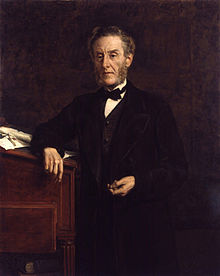
The modern era of institutionalized provision for the intendance of the mentally ill, began in the early 19th century with a large state-led effort. Public mental asylums were established in United kingdom after the passing of the 1808 County Asylums Act.[29] This empowered magistrates to build charge per unit-supported asylums in every county to house the many 'pauper lunatics'. Nine counties commencement practical, and the offset public aviary opened in 1811 in Nottinghamshire.[thirty] Parliamentary Committees were established to investigate abuses at individual madhouses like Bethlem Hospital – its officers were eventually dismissed and national attention was focused on the routine use of bars, bondage and handcuffs and the filthy atmospheric condition the inmates lived in.[31] However, it was non until 1828 that the newly appointed Commissioners in Lunacy were empowered to license and supervise private asylums.[32]
The Lunacy Deed 1845 was an of import landmark in the treatment of the mentally ill, as it explicitly inverse the condition of mentally ill people to patients who required treatment. The Act created the Lunacy Committee, headed by Lord Shaftesbury, to focus on lunacy legislation reform.[33] The committee was made up of eleven Metropolitan Commissioners who were required to carry out the provisions of the Deed:[34] the compulsory structure of asylums in every county, with regular inspections on behalf of the Home Secretary. All asylums were required to have written regulations and to take a resident qualified physician.[35] A national body for aviary superintendents – the Md-Psychological Association – was established in 1866 under the Presidency of William A. F. Browne, although the torso appeared in an earlier form in 1841.[36]
In 1838, France enacted a constabulary to regulate both the admissions into asylums and aviary services across the country. Édouard Séguin developed a systematic arroyo for training individuals with mental deficiencies,[37] and, in 1839, he opened the offset school for the severely retarded. His method of treatment was based on the assumption that the mentally scarce did not endure from illness.[38]
In the United States, the erection of state asylums began with the starting time police force for the cosmos of ane in New York, passed in 1842. The Utica Country Infirmary was opened approximately in 1850. The creation of this hospital, as of many others, was largely the work of Dorothea Lynde Dix, whose philanthropic efforts extended over many states, and in Europe as far every bit Constantinople. Many state hospitals in the United States were congenital in the 1850s and 1860s on the Kirkbride Plan, an architectural manner meant to have curative upshot.[39]
Looking into the tardily 19th and early 20th century history of the Homewood Retreat of Guelph, Ontario, and the context of commitments to asylums in North America and Uk, Cheryl Krasnick Warsh states that "the kin of aviary patients were, in fact, the major impetus backside delivery, only their motivations were based not then much upon greed equally upon the internal dynamics of the family, and upon the economic construction of western society in the 19th and early 20th centuries."[40]
Women in psychiatric institutions [edit]
Based on her study of cases from the Homewood Retreat, Cheryl Krasnick Warsh concludes that "the realities of the household in late Victorian and Edwardian middle grade society rendered sure elements—socially redundant women in particular—more susceptible to institutionalization than others."[40]
In the 18th to the early 20th century, women were sometimes institutionalised due to their opinions, their unruliness and their inability to be controlled properly past a primarily male-dominated culture.[41] There were financial incentives as well; earlier the passage of the Married Women's Property Human action 1882, all of a wife'due south assets passed automatically to her husband.
The men who were in accuse of these women, either a married man, begetter or brother, could transport these women to mental institutions, stating that they believed that these women were mentally sick considering of their stiff opinions. "Between the years of 1850–1900, women were placed in mental institutions for behaving in means the male guild did not agree with."[42] These men had the final say when it came to the mental health of these women, and so if they believed that these women were mentally ill, or if they simply wanted to silence the voices and opinions of these women, they could easily send them to mental institutions. This was an easy style to render them vulnerable and submissive.[43] [ dubious ]
An early fictional example is Mary Wollstonecraft'south posthumously published novel Maria: or, The Wrongs of Woman (1798), in which the title character is bars to an insane asylum when she becomes inconvenient to her husband. Real women's stories reached the public through court cases: Louisa Nottidge was abducted past male relatives to foreclose her committing her inheritance and her life to live in a revivalist clergyman'southward intentional community. Wilkie Collins based his 1859 novel The Woman in White on this case, dedicating information technology to Bryan Procter, the Commissioner for Lunacy. A generation after, Rosina Bulwer Lytton, daughter of the women's rights advocate Anna Wheeler, was locked upwards by her hubby Edward Bulwer-Lytton and afterwards wrote of this in A Blighted Life (1880).
In 1887, journalist Nellie Bly had herself committed to the Blackwell's Island Insane Asylum in New York Metropolis, in order to investigate weather there. Her account was published in the New York Earth paper, and in book form equally Ten Days in a Mad-House.
In 1902, Margarethe von Ende de, married woman of the German artillery manufacturer Friedrich Alfred Krupp, was consigned to an insane asylum by Kaiser Wilhelm 2, a family friend, when she asked him to answer to reports of her husband's gay orgies on Capri.[44]
New practices [edit]
In continental Europe, universities often played a part in the administration of the asylums.[45] In Germany, many practising psychiatrists were educated in universities associated with detail asylums.[45] However, considering Germany remained a loosely bound conglomerate of private states, it lacked a national regulatory framework for asylums.
Although Tuke, Pinel and others had tried to do abroad with concrete restraint, it remained widespread in the 19th century. At the Lincoln Asylum in England, Robert Gardiner Loma, with the back up of Edward Parker Charlesworth, pioneered a manner of handling that suited "all types" of patients, so that mechanical restraints and coercion could be dispensed with—a situation he finally achieved in 1838. In 1839 Sergeant John Adams and Dr. John Conolly were impressed by the work of Hill, and introduced the method into their Hanwell Asylum, past then the largest in the country. Colina's organisation was adapted, since Conolly was unable to supervise each bellboy as closely every bit Hill had done. By September 1839, mechanical restraint was no longer required for any patient.[46] [47]
William A. F. Browne (1805–1885) introduced activities for patients including writing, art, group activity and drama, pioneered early on forms of occupational therapy and art therapy, and initiated one of the earliest collections of artistic piece of work by patients, at Montrose Aviary.[48]
Rapid expansion [edit]
By the end of the 19th century, national systems of regulated asylums for the mentally ill had been established in virtually industrialized countries. At the turn of the century, Britain and France combined had merely a few hundred people in asylums,[49] but by the terminate of the century this number had risen to the hundreds of thousands. The United states housed 150,000 patients in mental hospitals by 1904. Deutschland housed more than 400 public and private sector asylums.[49] These asylums were disquisitional to the evolution of psychiatry as they provided places of practice throughout the world.[49]
Still, the hope that mental affliction could be ameliorated through treatment during the mid-19th century was disappointed.[50] Instead, psychiatrists were pressured by an ever-increasing patient population.[50] The boilerplate number of patients in asylums in the United States jumped 927%.[50] Numbers were like in Britain and Federal republic of germany.[50] Overcrowding was rampant in France, where asylums would commonly have in double their maximum capacity.[51] Increases in aviary populations may have been a result of the transfer of care from families and poorhouses, just the specific reasons as to why the increment occurred are all the same debated today.[52] No matter the cause, the pressure on asylums from the increase was taking its toll on the asylums and psychiatry as a specialty. Asylums were once more turning into custodial institutions[53] and the reputation of psychiatry in the medical world had hit an extreme low.[54]
In the 1800s, middle form facilities became more common, replacing private care for wealthier persons. However, facilities in this menstruation were largely oversubscribed. Individuals were referred to facilities either by the community or past the criminal justice organisation. Dangerous or violent cases were usually given precedence for access. A survey taken in 1891 in Cape Town, South Africa shows the distribution betwixt dissimilar facilities. Out of 2046 persons surveyed, ane,281 were in private dwellings, 120 in jails and 645 in asylums, with men representing near 2-thirds of the number surveyed.[55]
Defining someone equally insane was a necessary prerequisite for existence admitted to a facility. A doctor was only chosen after someone was labelled insane on social terms and had become socially or economically problematic. Until the 1890s, little distinction existed betwixt the lunatic and criminal lunatic. The term was frequently used to law vagrancy as well as paupers and the insane. In the 1850s, lurid rumours that medical doctors were declaring normal people "insane" in Uk, were spread by the printing causing widespread public anxiety. The fear was that people who were a source of embarrassment to their families were conveniently disposed of into asylums with the willing connivance of the psychiatric profession. This sensationalism appeared in widely read novels of the time, including The Woman in White.[55] [56]
20th century [edit]
Physical therapies [edit]
A series of radical concrete therapies were developed in key and continental Europe in the late 1910s, the 1920s and nigh peculiarly, the 1930s. Among these, nosotros may annotation the Austrian psychiatrist Julius Wagner-Jauregg's malarial therapy for general paresis of the insane (or neurosyphilis) first used in 1917, and for which he won a Nobel Prize in 1927.[57] This treatment heralded the beginning of a radical and experimental era in psychiatric medicine that increasingly bankrupt with an aviary-based culture of therapeutic nihilism in the handling of chronic psychiatric disorders,[58] most particularly dementia praecox (increasingly known as schizophrenia from the 1910s, although the ii terms were used more than or less interchangeably until at to the lowest degree the end of the 1930s), which were typically regarded as hereditary degenerative disorders and therefore unamenable to any therapeutic intervention.[59] Malarial therapy was followed in 1920 by barbiturate-induced deep sleep therapy to treat dementia praecox, which was popularised by the Swiss psychiatrist Jakob Klaesi. In 1933 the Vienna-based psychiatrist Manfred Sakel introduced insulin shock therapy, and in August 1934 Ladislas J. Meduna, a Hungarian neuropathologist and psychiatrist working in Budapest, introduced cardiazol shock therapy (cardiazol is the tradename of the chemic chemical compound pentylenetetrazol, known by the tradename metrazol in the United states of america), which was the first convulsive or seizure therapy for a psychiatric disorder. Again, both of these therapies were initially targeted at curing dementia praecox. Cardiazol shock therapy, founded on the theoretical notion that in that location existed a biological antagonism between schizophrenia and epilepsy and that therefore inducing epileptiform fits in schizophrenic patients might consequence a cure, was superseded by electroconvulsive therapy (ECT), invented past the Italian neurologist Ugo Cerletti in 1938.[threescore]

The utilize of psychosurgery was narrowed to a very small number of people for specific indications. Egas Moniz performed the first leucotomy, or lobotomy in Portugal in 1935, which targets the brain'southward frontal lobes.[4] This was shortly thereafter adapted by Walter Freeman and James Due west. Watts in what is known as Freeman–Watts procedure or the standard prefrontal lobotomy. From 1946, Freeman developed the transorbital lobotomy, using a device akin to an ice-pick. This was an "office" procedure which did non accept to be performed in a surgical theatre and took as footling as fifteen minutes to complete. Freeman is credited with the popularisation of the technique in the Usa. In 1949, 5,074 lobotomies were carried out in the United States and past 1951, 18,608 people had undergone the controversial procedure in that country.[61] Ane of the most famous people to have a lobotomy was the sis of John F. Kennedy, Rosemary Kennedy, who was rendered profoundly intellectually disabled every bit a issue of the surgery.
In modern times, insulin shock therapy and lobotomies are viewed equally existence almost as barbaric as the Clamor "treatments", although the insulin shock therapy was still seen every bit the but option which produced whatever noticeable effect on patients. ECT is even so used in the West in the 21st century, but it is seen as a last resort for handling of mood disorders and is administered much more safely than in the by.[62] Elsewhere, peculiarly in India, utilise of ECT is reportedly increasing, as a cost-effective alternative to drug handling.[ commendation needed ] The outcome of a shock on an overly excitable patient often allowed these patients to be discharged to their homes, which was seen by administrators (and often guardians) as a preferable solution to institutionalisation. Lobotomies were performed in the thousands from the 1930s to the 1950s, and were ultimately replaced with modern psychotropic drugs.
Eugenics motion [edit]
The eugenics movement of the early 20th century led to a number of countries enacting laws for the compulsory sterilization of the "feeble minded", which resulted in the forced sterilization of numerous psychiatric inmates.[63] Equally late every bit the 1950s, laws in Japan immune the forcible sterilization of patients with psychiatric illnesses.[64]
Nether Nazi Germany, the Aktion T4 euthanasia programme resulted in the killings of thousands of the mentally sick housed in land institutions. In 1939, the Nazis secretly began to exterminate the mentally sick in a euthanasia campaign. Around 6,000 disabled babies, children and teenagers were murdered by starvation or lethal injection.[65]
Psychiatric internment as a political device [edit]
Psychiatrists effectually the world have been involved in the suppression of private rights by states wherein the definitions of mental affliction had been expanded to include political defiance.[66] : six Nowadays, in many countries, political prisoners are sometimes confined to mental institutions and abused therein.[67] : 3 Psychiatry possesses a built-in capacity for abuse which is greater than in other areas of medicine.[68] : 65 The diagnosis of mental disease tin serve as proxy for the designation of social dissidents, allowing the state to hold persons against their will and to insist upon therapies that work in favour of ideological conformity and in the broader interests of society.[68] : 65

In a monolithic state, psychiatry can be used to bypass standard legal procedures for establishing guilt or innocence and allow political incarceration without the ordinary odium attaching to such political trials.[68] : 65 In Nazi Germany in the 1940s, the 'duty to intendance' was violated on an enormous calibration: A reported 300,000 individuals were sterilised and 100,000 killed in Germany lone, as were many thousands farther afield, mainly in Eastern Europe.[69]
From the 1960s up to 1986, political abuse of psychiatry was reported to exist systematic in the Soviet Union, and to surface on occasion in other Eastern European countries such as Romania, Republic of hungary, Czechoslovakia and Yugoslavia.[68] : 66 A "mental health genocide" reminiscent of the Nazi aberrations has been located in the history of South African oppression during the apartheid era.[lxx] A connected misappropriation of the subject area was subsequently attributed to the People's Commonwealth of China.[71]
Drugs [edit]
The 20th century saw the development of the first effective psychiatric drugs.
The first antipsychotic drug, chlorpromazine (known under the trade proper name Largactil in Europe and Thorazine in the United States), was first synthesised in France in 1950. Pierre Deniker, a psychiatrist of the Saint-Anne Psychiatric Centre in Paris, is credited with first recognising the specificity of action of the drug in psychosis in 1952. Deniker travelled with a colleague to the United States and Canada promoting the drug at medical conferences in 1954. The first publication regarding its use in North America was fabricated in the same year past the Canadian psychiatrist Heinz Lehmann, who was based in Montreal. Also in 1954 another antipsychotic, reserpine, was commencement used by an American psychiatrist based in New York, Nathan S. Kline. At a Paris-based colloquium on neuroleptics (antipsychotics) in 1955 a series of psychiatric studies were presented by, amidst others, Hans Hoff (Vienna), Dr. Ihsan Aksel (Istanbul), Felix Labarth (Basle), Linford Rees (London), Sarro (Barcelona), Manfred Bleuler (Zurich), Willi Mayer-Gross (Birmingham), Winford (Washington) and Denber (New York) attesting to the effective and concordant action of the new drugs in the treatment of psychosis.[ commendation needed ]

Advertising for Thorazine (chlorpromazine) from the early 1960s[72]
The new antipsychotics had an immense affect on the lives of psychiatrists and patients. For instance, Henri Ey, a French psychiatrist at Bonneval, related that betwixt 1921 and 1937 merely 6% of patients suffering from schizophrenia and chronic delirium were discharged from his establishment. The comparable effigy for the period from 1955 to 1967, after the introduction of chlorpromazine, was 67%. Between 1955 and 1968 the residential psychiatric population in the United States dropped by 30%.[73] Newly developed antidepressants were used to treat cases of depression, and the introduction of musculus relaxants allowed ECT to be used in a modified form for the treatment of severe low and a few other disorders.[four]
The discovery of the mood stabilizing effect of lithium carbonate by John Cade in 1948 would eventually revolutionise the treatment of bipolar disorder, although its use was banned in the United States until the 1970s.[74]
United States: reform in the 1940s [edit]
From 1942 to 1947, careful objectors in the US assigned to psychiatric hospitals under Civilian Public Service exposed abuses throughout the psychiatric care arrangement and were instrumental in reforms of the 1940s and 1950s. The CPS reformers were peculiarly active at the Philadelphia State Hospital where four Quakers initiated The Bellboy magazine as a style to communicate ideas and promote reform. This periodical later became The Psychiatric Aide, a professional person journal for mental health workers. On 6 May 1946, Life magazine printed an exposé of the psychiatric system by Albert Q. Maisel based on the reports of COs.[75] Another effort of CPS, namely the Mental Hygiene Project, became the national Mental Health Foundation. Initially skeptical about the value of Noncombatant Public Service, Eleanor Roosevelt, impressed by the changes introduced by COs in the mental wellness system, became a sponsor of the National Mental Health Foundation and actively inspired other prominent citizens including Owen J. Roberts, Pearl Buck and Harry Emerson Fosdick to join her in advancing the system's objectives of reform and humane treatment of patients.[ citation needed ]
Deinstitutionalisation [edit]
By the beginning of the 20th century, ever-increasing admissions had resulted in serious overcrowding. Funding was often cut, peculiarly during periods of economic decline, and during wartime in particular many patients starved to expiry. Asylums became notorious for poor living conditions, lack of hygiene, overcrowding, and ill-treatment and corruption of patients.[76]
The first community-based alternatives were suggested and tentatively implemented in the 1920s and 1930s, although asylum numbers connected to increase up to the 1950s. The motility for deinstitutionalisation came to the fore in various Western countries in the 1950s and 1960s.
The prevailing public arguments, fourth dimension of onset, and pace of reforms varied by land.[76] Class activeness lawsuits in the United States, and the scrutiny of institutions through inability activism and antipsychiatry, helped expose the poor atmospheric condition and treatment. Sociologists and others argued that such institutions maintained or created dependency, passivity, exclusion and disability, causing people to exist institutionalised.
There was an statement that customs services would be cheaper. Information technology was suggested that new psychiatric medications made it more viable to release people into the community.[77]
At that place were differing views on deinstitutionalization, however, in groups such as mental wellness professionals, public officials, families, advocacy groups, public citizens and unions.[78]
Today [edit]
Africa[ vague ] [edit]
- Republic of uganda has one psychiatric infirmary.[76]
- S Africa currently has 27 registered psychiatric hospitals. These hospitals are spread throughout the state. Some of the most well-known institutions are: Weskoppies Psychiatric Hospital, colloquially known as Groendakkies ("Petty Green Roofs") and Denmar Psychiatric Hospital in Pretoria, TARA[79] in Johannesburg, and Valkenberg Hospital in Cape Town.
Asia[ vague ] [edit]
In Japan, the number of hospital beds has risen steadily over the final few decades.[76]
In Hong Kong, a number of residential care services such equally one-half-mode houses, long-stay intendance homes, and supported hostels are provided for the discharged patients. In addition, a number of community support services such as Community Rehabilitation Day Services, Community Mental Health Link, Customs Mental Health Care, etc. accept been launched to facilitate the re-integration of patients into the community.
Europe[ vague ] [edit]
Countries where deinstitutionalisation has happened may be experiencing a process of "re-institutionalisation" or relocation to unlike institutions, as evidenced by increases in the number of supported housing facilities, forensic psychiatric beds and rising numbers in the prison population.[fourscore]
New Zealand [edit]
New Zealand established a reconciliation initiative in 2005 in the context of ongoing compensation payouts to ex-patients of state-run mental institutions in the 1970s to 1990s. The forum heard of poor reasons for admissions; unsanitary and overcrowded weather; lack of communication to patients and family members; physical violence and sexual misconduct and abuse; inadequate complaints mechanisms; pressures and difficulties for staff, within an disciplinarian psychiatric hierarchy based on containment; fright and humiliation in the misuse of seclusion; over-use and abuse of ECT, psychiatric medication and other treatments/punishments, including group therapy, with continued adverse effects; lack of support on discharge; interrupted lives and lost potential; and continued stigma, prejudice and emotional distress and trauma.
There were some references to instances of helpful aspects or kindnesses despite the system. Participants were offered counselling to assist them deal with their experiences, and communication on their rights, including access to records and legal redress.[81]
Southward America [edit]
In several South American countries[ which? ], the full number of beds in asylum-type institutions has decreased, replaced by psychiatric inpatient units in general hospitals and other local settings.[76]
United Kingdom [edit]
At the start of the 19th century, there were, possibly, a few thousand "lunatics" housed in a variety of disparate institutions; but, by the get-go of the 20th century, that figure had grown to about 100,000. This growth coincided with the development of "alienism," now known as psychiatry, as a medical specialty.[v] : 14
United States [edit]
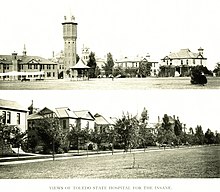
Views of Toledo State Hospital for the Insane
The U.s. has experienced two waves of deinstitutionalization. Wave one began in the 1950s and targeted people with mental illness.[82] The 2d wave began roughly fifteen years after and focused on individuals who had been diagnosed with a developmental disability (east.grand. Intellectual Disability).[82]
A procedure of indirect cost-shifting may have led to a form of "re-institutionalization" through the increased utilise of jail detention for those with mental disorders deemed unmanageable and noncompliant.[83] In summer 2009, author and columnist Heather Mac Donald stated in City Journal, "jails have get society's principal mental institutions, though few have the funding or expertise to bear out that office properly... at Rikers, 28% of the inmates require mental health services, a number that rises each year."[84]
Come across besides [edit]
- Deinstitutionalization
- History of mental disorders
- Kirkbride Programme
- Timeline of psychiatry
- History of psychiatric institutions in Mainland china
- List of asylums commissioned in England and Wales
References [edit]
- ^ Koenig, Harold George (2005). Faith and mental health: religious resource for healing. Templeton Foundation Printing. ISBN978-1-932031-91-ane.
- ^ a b c Porter, Roy (1997). The Greatest Benefit to Mankind: A Medical History of Humanity from Antiquity to the Present. London: Fontana Press. ISBN978-0006374541.
- ^ Gary D. Albrecht, Katherine D. Seelman, Michael Coffin: Handbook of Inability Studies, p.20 [1]
- ^ a b c "Mental Wellness History Timeline". Studymore.org.uk. Retrieved 15 April 2014.
- ^ a b c d due east f g h i j Porter, Roy (2006). Madmen: A Social History of Madhouses, Mad-Doctors & Lunatics (Sick. ed. [originally published 1987] ed.). Stroud: Tempus. ISBN9780752437309.
- ^ a b Suzuki, Akihito (1991). "Lunacy, in Seventeenth- and Eighteenth-Century England: Analysis of Quarter Sessions Records Part I". History of Psychiatry. ii (8): 437–56. doi:10.1177/0957154X9100200807. PMID 11612606. S2CID 2250614.
- ^ Andrews, Jonathan (2004). "The Ascent of the Asylum". In Deborah Brunton (ed.). Medicine Transformed: Wellness, Disease & Society in Europe, 1800–1930. Manchester: The Open up University. pp. 298–330. ISBN978-0719067358.
- ^ Suzuki, Akihito (1992). "Lunacy, in Seventeenth- and Eighteenth-Century England: Analysis of Quarter Sessions Records Function Two". History of Psychiatry. 3 (8): 29–44. doi:10.1177/0957154x9200300903. PMID 11612665. S2CID 28734153.
- ^ Allderidge, Patricia (1979). "Management and Mismanagement at Clamor, 1547–1633". In Webster, Charles (ed.). Wellness, Medicine and Mortality in the Sixteenth Century. Cambridge: Cambridge University Press. p. 145. ISBN9780521226431.
- ^ Stevenson, Christine; Jonathan Andrews; Asa Briggs; Roy Porter; Penny Tucker; Keir Waddington (1997). "The Architecture of Bethlem at Moorfields". History of Bethlem. London & New York: Routledge. p. 51. ISBN978-0415017732.
- ^ a b Winston, Mark (1994). "The Bethel at Norwich: An Eighteenth-Century Hospital for Lunatics". Medical History. 38 (1): 27–51. doi:10.1017/s0025727300056039. PMC1036809. PMID 8145607.
- ^ a b c Parry-Jones, William Ll. (1972). The Trade in Lunacy: A Report of Individual Madhouses in England in the Eighteenth and Nineteenth Centuries . London: Routledge. ISBN9780710070517.
- ^ a b William A. White (1920). . In Rines, George Edwin (ed.). Encyclopedia Americana.
- ^ "THE FIRST INSANE Asylum.; To Virginia Belongs the Credit in This Country". The New York Times. xvi July 1900. Retrieved 1 Nov 2009.
- ^ James J. Walsh (1913). . In Herbermann, Charles (ed.). Cosmic Encyclopedia. New York: Robert Appleton Company.
- ^ Noll, Richard (2007). The Encyclopedia of Schizophrenia and Other Psychotic Disorders (3rd ed.). New York: Facts on File. ISBN978-0816064052.
- ^ a b c d e f grand h i j MacKenzie, Charlotte (1992). Psychiatry for the Rich: A History of Ticehurst Private Asylum. London: Routledge. ISBN978-0415088916.
- ^ Elkes, A. & Thorpe, J.G. (1967). A Summary of Psychiatry. London: Faber & Faber, p. xiii.
- ^ Weiner DB (September 1979). "The apprenticeship of Philippe Pinel: a new document, "observations of Citizen Pussin on the insane"". Am J Psychiatry. 136 (nine): 1128–34. doi:10.1176/ajp.136.ix.1128. PMID 382874.
- ^ Bukelic, Jovan (1995). "2". In Mirjana Jovanovic (ed.). Neuropsihijatrija za III razred medicinske skole (in Serbian) (7th ed.). Belgrade: Zavod za udzbenike i nastavna sredstva. p. 7. ISBN978-86-17-03418-2.
- ^ "Philippe Pinel". Psychology.jrank.org. Retrieved 15 Apr 2014.
- ^ Gerard DL (1998). "Chiarugi and Pinel considered: Soul'due south brain/person's mind". J Hist Behav Sci. 33 (four): 381–403. doi:x.1002/(SICI)1520-6696(199723)33:4<381::Aid-JHBS3>three.0.CO;ii-S. [ dead link ]
- ^ Cherry, Charles Fifty. (1989), A Serenity Haven: Quakers, Moral Treatment, and Asylum Reform, London & Toronto: Associated University Presses
- ^ Digby, Anne (1983), Madness, Morality and Medicine: A Study of the York Retreat, Cambridge: Cambridge University Press
- ^ Glover, Mary R. (1984), The Retreat, York: An Early Experiment in the Treatment of Mental Affliction, York: Ebor Printing
- ^ Borthwick, Annie; Holman, Chris; Kennard, David; McFetridge, Mark; Messruther, Karen; Wilkes, Jenny (2001). "The relevance of moral treatment to gimmicky mental health care". Journal of Mental Health. 10 (4): 427–439. doi:10.1080/09638230124277. S2CID 218906106.
- ^ Borthwick A.; Holman C.; Kennard D.; McFetridge Grand.; Messruther K.; Wilkes J. (2001). "The relevance of moral handling to contemporary mental health care". Journal of Mental Wellness. x (four): 427–439. doi:10.1080/09638230124277. S2CID 218906106.
- ^ Müller, Christian. "Guggenbühl, Johann Jakob". www.hls-dhs-dss.ch (in German). Retrieved 23 June 2016.
- ^ Roberts, Andrew. "Mental Health History Timeline;1808". studymore.org.uk . Retrieved 24 June 2016.
- ^ Roberts, Andrew. "Mental Health History Timeline;1811". studymore.org.uk . Retrieved 24 June 2016.
- ^ Roberts, Andrew. "Index of Lunatic Asylums and Mental Hospitals;1815". studymore.org.united kingdom . Retrieved 24 June 2016.
- ^ Roberts, Andrew. "The Lunacy Commission, A Study of its Origin, Emergence and Character;Chap.3.1.1". studymore.org.uk . Retrieved 24 June 2016.
- ^ Unsworth, Clive."Law and Lunacy in Psychiatry'due south 'Golden Age'", Oxford Journal of Legal Studies. Vol. 13, No. 4. (Winter, 1993), pp. 482.
- ^ Roberts, Andrew. "The Lunacy Commission, A Study of its Origin, Emergence and Character;Chap.5.1.iii". studymore.org.uk . Retrieved 24 June 2016.
- ^ Roberts, Andrew. "The Lunacy Commission as a government section". studymore.org.uk . Retrieved 24 June 2016.
- ^ Shorter 1997, p. 34, 41.
- ^ King. A History of Psychology p.214. ISBN 9780205512133
- ^ "Edouard Seguin (American psychiatrist)". Encyclopædia Britannica. 6 December 2013. Retrieved 15 Apr 2014.
- ^ Yanni, Carla (2007). The Compages of Madness: Insane Asylums in the U.s.a.. Minneapolis: Minnesota University Printing. ISBN978-0-8166-4939-six.
- ^ a b Warsh, Cheryl Krasnick (1988). "The First Mrs. Rochester: Wrongful Confinement, Social Back-up, and Commitment to the Private Asylum, 1883‑1923". Historical Papers. 23 (i): 145–167. doi:x.7202/030985ar. hdl:10613/3065.
- ^ "Women and Psychiatry – Hysteria, Feminism, and Psychoanalysis". Retrieved 9 July 2016.
- ^ Packard, E.P. (1873). Mod persecution, or, Insane asylums unveiled as demonstrated past the report of the Investigating Committee of the Legislature of Illinois. Hartford: Investigating Committee of the Legislature of Illinois.
- ^ Geller, Jeffrey F. (1994). Women of the Asylum: Voices from Behind the Walls, 1840–1945. Ballast Books.
- ^ "Storia gay - Friedrich Alfred Krupp (1854-1902), l'omosessualità eastward lo scandalo di Capri". world wide web.giovannidallorto.com.
- ^ a b Shorter 1997, p. 35.
- ^ Suzuki, Akihto (January 1995). "The politics and ideology of not-restraint: the case of the Hanwell Aviary". Medical History. 39 (ane): 1–17. doi:10.1017/s0025727300059457. PMC1036935. PMID 7877402.
- ^ Edited by: Bynum, Due west. F; Porter, Roy; Shepherd, Michael (1988) The Anatomy of Madness: Essays in the history of psychiatry. Vol.three. The Asylum and its psychiatry. Routledge. London EC4
- ^ "British Outsider Fine art Exhibitions, John Joseph Sheehy London and Grouping Prove in Paris 2008". Retrieved xv Jan 2009.
- ^ a b c Shorter 1997, p. 34.
- ^ a b c d Shorter 1997, p. 46.
- ^ Shorter 1997, p. 47.
- ^ Shorter 1997, p. 48-49.
- ^ Rothman, D.J. (1990). The Discovery of the Asylum: Social Society and Disorder in the New Republic. Boston: Piddling Brown, p. 239. ISBN 978-0-316-75745-4
- ^ Shorter 1997, p. 65.
- ^ a b Roy Porter; David Wright (2003). The Confinement of the Insane: International Perspectives, 1800–1965. Cambridge University Printing. ISBN978-0-521-80206-2.
- ^ "by the brooke: lunacy panic". Bythebrooke.blogspot.com. 12 November 2008. Retrieved fifteen April 2014.
- ^ Brown Edward K (2000). "Why Wagner-Jauregg won the Nobel Prize for discovering malaria therapy for Full general Paresis of the Insane". History of Psychiatry. 11 (44): 371–382. doi:10.1177/0957154X0001104403. S2CID 71299293.
- ^ Ugo Cerletti, for instance, described psychiatry during the inter-war period equally a "funereal science". Quoted in Shorter 1997, p. 218
- ^ Hoenig J (1995). "Schizophrenia. In Berrios, High german and Porter, Roy (Eds.), A History of Clinical Psychiatry. Athlone: p. 337; Meduna, L. J. (1985). Autobiography of L.J. Meduna". Convulsive Therapy. 1 (1): 53.
- ^ Shorter 1997, p. 190–225.
- ^ Shorter 1997, p. 226–229.
- ^ Yanni, Carla. (12 April 2007). The Architecture of Madness: Insane Asylums in the United states (Architecture, Landscape and Amer Culture) (1 ed.). University of Minnesota Printing. pp. 53–62. ISBN978-0-8166-4940-ii.
- ^ World Wellness Organization. "Eliminating forced, coercive and otherwise involuntary sterilization: an interagency statement" (PDF). unaids.org . Retrieved 23 June 2016.
- ^ TSUCHIYA, Takashi. "Japanese Eugenic Sterilization, Newsletter of the Network on Ethics and Intellectual Disability, Vol.iii, No.1 [Autumn 1997], pp.1–four.)". www.lit.osaka-cu.ac.jp . Retrieved 23 June 2016.
- ^ Torrey Due east.F.; Yolken R.H. (16 September 2009). "Psychiatric Genocide: Nazi Attempts to Eradicate Schizophrenia" (PDF). Schizophrenia Bulletin. 36 (ane): 26–32. doi:10.1093/schbul/sbp097. PMC2800142. PMID 19759092. Archived from the original (PDF) on 3 August 2012.
- ^ Semple, David; Smyth, Roger; Burns, Jonathan (2005). Oxford handbook of psychiatry. Oxford: Oxford University Printing. p. 6. ISBN978-0-19-852783-1.
- ^ Noll, Richard (2007). The encyclopedia of schizophrenia and other psychotic disorders. Infobase Publishing. p. 3. ISBN978-0-8160-6405-2.
- ^ a b c d Medicine betrayed: the participation of doctors in human rights abuses. Zed Books. 1992. p. 65. ISBN978-1-85649-104-iv.
- ^ Birley, J. L. T. (January 2000). "Political abuse of psychiatry". Acta Psychiatrica Scandinavica. 101 (399): 13–15. doi:10.1111/j.0902-4441.2000.007s020[dash]3.10. PMID 10794019.
- ^ "Press briefing exposes mental health genocide during apartheid, 14 June 1997". South African Authorities Information. Retrieved 16 January 2012.
- ^ van Voren, Robert (January 2010). "Political Abuse of Psychiatry—An Historical Overview". Schizophrenia Bulletin. 36 (1): 33–35. doi:10.1093/schbul/sbp119. PMC2800147. PMID 19892821.
- ^ The text reads: When the patient lashes out against "them" – THORAZINE (brand of chlorpromazine) quickly puts an end to his violent outburst. 'Thorazine' is peculiarly effective when the psychotic episode is triggered by delusions or hallucinations. At the first of treatment, Thorazine's combination of antipsychotic and sedative effects provides both emotional and physical calming. Assaultive or destructive beliefs is apace controlled. As therapy continues, the initial sedative effect gradually disappears. Simply the antipsychotic effect continues, helping to dispel or modify delusions, hallucinations and confusion, while keeping the patient calm and approachable. SMITH KLINE AND FRENCH LABORATORIES leaders in psychopharmaceutical inquiry.
- ^ Thuillier, Jean (1999). Ten Years that Changed the Face up of Mental Disease. Trans. Gordon Hickish. Martin Dunitz: pp. 110,114, 121–123, 130. ISBN one-85317-886-1
- ^ Shorter, Edward (1 June 2009). "The history of lithium therapy". Bipolar Disorders. 11 Suppl 2: 4–9. doi:10.1111/j.1399-5618.2009.00706.x. PMC3712976. PMID 19538681.
- ^ Albert Q. Maisel (half-dozen May 1946). Bedlam 1946. LIFE magazine. p. 102.
- ^ a b c d eastward Fakhourya W, Priebea S (Baronial 2007). "Deinstitutionalization and reinstitutionalization: major changes in the provision of mental healthcare". Psychiatry. 6 (8): 313–316. doi:10.1016/j.mppsy.2007.05.008.
- ^ Rochefort DA (Spring 1984). "Origins of the "Third psychiatric revolution": the Community Mental Health Centers Act of 1963". J Health Polit Policy Law. 9 (i): i–thirty. doi:x.1215/03616878-ix-1-1. PMID 6736594. Archived from the original on nine July 2012. Retrieved 29 November 2009.
- ^ Scherl DJ, Macht LB (September 1979). "Deinstitutionalization in the absence of consensus". Hosp Community Psychiatry. 30 (nine): 599–604. doi:10.1176/ps.30.9.599. PMID 223959. Archived from the original on 6 January 2012.
- ^ "Tara H Moross Centre Hospital – Psychiatric Ward (Ward 8)". Medpages. Retrieved 28 May 2018.
- ^ Priebe S, Badesconyi A, Fioritti A, et al. (January 2005). "Reinstitutionalisation in mental wellness care: comparing of data on service provision from six European countries". BMJ. 330 (7483): 123–6. doi:10.1136/bmj.38296.611215.AE. PMC544427. PMID 15567803.
- ^ Dept of Internal Diplomacy, New Zealand Regime. Te Āiotanga: Written report of the Confidential Forum for Former In-Patients of Psychiatric Hospitals June 2007
- ^ a b Stroman, Duane. 2003. "The Disability Rights Movement: From Deinstitutionalization to Self-determination. University Printing of America.
- ^ Domino ME, Norton EC, Morrissey JP, Thakur N (October 2004). "Cost shifting to jails after a modify to managed mental wellness care". Wellness Serv Res. 39 (5): 1379–401. doi:10.1111/j.1475-6773.2004.00295.x. PMC1361075. PMID 15333114.
- ^ Mac Donald, Heather. "The Jail Inferno". City Journal . Retrieved 27 July 2009.
Farther reading [edit]
- Yanni, Carla (2007). The architecture of madness: insane asylums in the U.s.. U of Minnesota Press. ISBN978-0-8166-4939-half-dozen.
- (in French) Michel Foucault, Histoire de la folie à fifty'âge classique, 1961, Gallimard, Tel, 688 p. ISBN 978-2070295821
- (in French) Claude Quétel, Histoire de la folie : De l'Antiquité à nos jours, 2009, Editions Tallandier, Texto, 618 pages. ISBN 978-2847349276
- Shorter, Due east (1997), A History of Psychiatry: From the Era of the Asylum to the Age of Prozac, New York: John Wiley & Sons, Inc., ISBN978-0-471-24531-v
Source: https://en.wikipedia.org/wiki/Lunatic_asylum
0 Response to "Crazy Lady Goes Off on Family in Hospital"
Postar um comentário